
How AI Changes the College Planning Conversation — and why every family deserves its own baseline before they hire, listen, or trust.
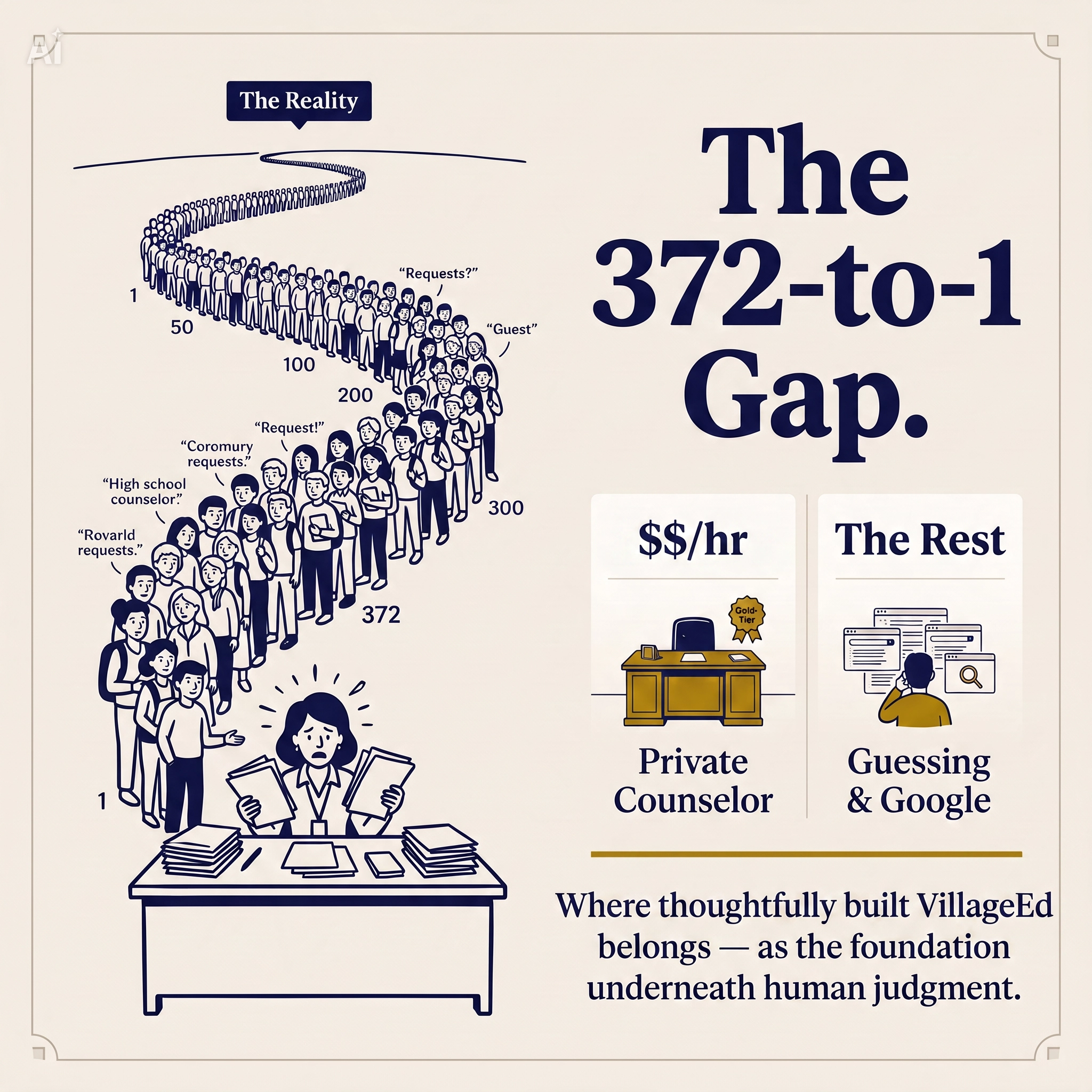
Families who want sustained, personalized college-planning support have traditionally relied on a private counselor—an option that can be valuable, but financially out of reach for many. The good ones are genuinely valuable — and genuinely expensive. Published prices vary widely. IECA says many consultants charge just under $140 per hour, while higher-touch providers and specialized firms may charge considerably more. Comprehensive packages can range from several thousand dollars to five figures, depending on scope, location, and experience. For most families, that math simply doesn’t work. So they do what everyone else does: guess, Google, and hope the school counselor has time — even though the American School Counselor Association (ASCA) reports a national K–12 student-to-school-counselor ratio of 372 to 1 for 2024–25, compared with its recommended ratio of 250 to 1.
That gap is exactly where thoughtfully built VillageEd belongs — not as a replacement for human judgment, but as the foundation underneath it.
Although every counselor brings a different approach, much of college planning involves a recurring set of responsibilities.

Notice something about that list. Jobs one through seven contain a significant information-management component. VillageEd handles the structured guidance layer: interpreting the student’s record, identifying priorities, matching opportunities, sequencing decisions, and turning recommendations into specific actions. Counselors add high-context judgment, relationship, advocacy, and personal coaching where those matter most.
Job eight deserves a hard look because it is the one anxious parents care about most—and no single conversation or assessment can reliably settle a teenager’s direction. The strongest guidance combines reflection with real-world experimentation over time. Fields get found by doing — take the free college course, enter the competition, join the lab — and seeing what sticks. That’s an experiment loop, and it’s what VillageEd actually runs: it reads the interests already visible in a student’s record, proposes cheap real-world tests of them (a tuition-free environmental science course two miles away, say), and watches the response, month after month, as the record grows. VillageEd calls itself a field guide, and the term is exact: a field guide doesn’t tell you what bird you should be seeing — it helps you identify the one in front of you from its actual markings. The software doesn’t sit your kid down and pick a major — no one honestly can — but it generates the evidence a real decision is made from. A mentor who talks that evidence through with the student is a genuine complement. Conversation is most valuable when it helps a student interpret evidence gathered through real experiences.
The ninth job is the clean human one. Coaching a teenager through drafts of a deeply personal essay is judgment-and-relationship work, and it’s where a skilled human earns their fee. Keep the division in mind — evidence and information from software, judgment and relationship from people — it’s the key to using both well.
And the information work is not generic. When VillageEd surfaces a school, it comes with the details a counselor would otherwise bill hours to compile: the share of undergraduates receiving grants or scholarships, the average aid package and resulting net price, whether the school has a particular commitment to first-generation students. Each application arrives with its actual essay prompts — word counts, which are required and which optional — and a dated task sequence tuned to the platform, including details a busy family could miss, such as Cal State Apply allowing students to begin working on the application August 1, opening submissions October 1, and using campus- and major-specific availability after the November 30 priority deadline.
The opportunity scouting works the same way. A student interested in environmental science doesn’t get “look into summer programs” — they get a specific recommendation: tuition-free college courses through their local community college’s concurrent enrollment program, two miles from home, covered by the state’s Promise Grant, with the registration deadline, the eligibility requirements, an explanation of why it fits (a course that fills a gap in the profile and shows academic momentum between junior and senior year), and the next step spelled out — including, notably, “get your school counselor’s approval before the fall registration window.” Read that last part again: VillageEd’s own recommendations route families back to the humans in their corner. This is exactly the knowledge families assume they must pay a professional to possess — delivered with the reasoning attached, in writing.
For families who do work with a private counselor, the economics get better, not worse. When counselor time is billed hourly—or packaged into a substantial engagement—families naturally want to use that time well. The most expensive way to use a counselor is to have them do inventory: gathering the student’s history, reconstructing the activity list, figuring out where things stand, chasing deadlines and logistics. Industry observers note that even the best counselors spend a significant share of their time on exactly this kind of administrative groundwork rather than on high-value judgment.
A well-organized VillageEd profile may reduce the time spent reconstructing basic history and gathering documents. The student’s record is organized, the assessment is done, the semester plan exists, and the opportunity pipeline is already running. The counselor’s hours — the scarce, expensive resource — go where humans genuinely outperform software: essay coaching above all, plus nuanced strategy, reading between the lines of a student’s story, and the judgment calls that come from years of experience. A comprehensive engagement may involve dozens of hours; a family that offloads the information work could buy a focused essay-and-strategy engagement instead of a full package, or get dramatically more essay depth from the same hours. Either way, more of the money lands on the work only a human can do.
There’s a bonus most families don’t anticipate: the essays get better when the groundwork is done. A student who has spent semesters following a coherent plan — building real activities, tracked and documented along the way — walks into essay season with material worth writing about and a Profile Builder that already holds the raw narrative. The counselor isn’t excavating; they’re refining.
One more thing humans do that software never will: play the neutral third party. Part of what families quietly pay counselors for is that the counselor can push the student so the parents don’t have to — defusing the kitchen-table tension that builds when Mom becomes the deadline enforcer. VillageEd helps here too, in its own way: when the plan and the deadlines come from the system, the nagging isn’t personal. But for families who want a trusted adult in that role, that’s a legitimate — and human — reason to hire one.
When a family arrives with a plan, the conversation changes—from “Tell us what to do” to “Here’s what we’re doing. Help us pressure-test it.” That is a better conversation for everyone, including the counselor.
Here is a fact that surprises most parents, stated plainly by the industry’s own trade association. In the IECA’s words:
Licensure does not exist in any state and anyone can claim to be an independent educational consultant. However, potential IECA members go through an extensive and rigorous application process. They must have a …
The profession is not state-licensed, so families need to evaluate qualifications carefully. Reputable associations such as IECA impose meaningful experience, education, ethics, and professional-development standards on their members.
And that’s a hard burden to carry empty-handed. Without an independent picture of where your student stands, it is harder to evaluate a counselor’s assessment, compare recommendations, or ask informed questions in the first consultation. You are not simply buying guidance; you are also relying on the counselor’s framework for understanding the guidance. It is the same reason people value a second opinion or an independent inspection before making an important decision.
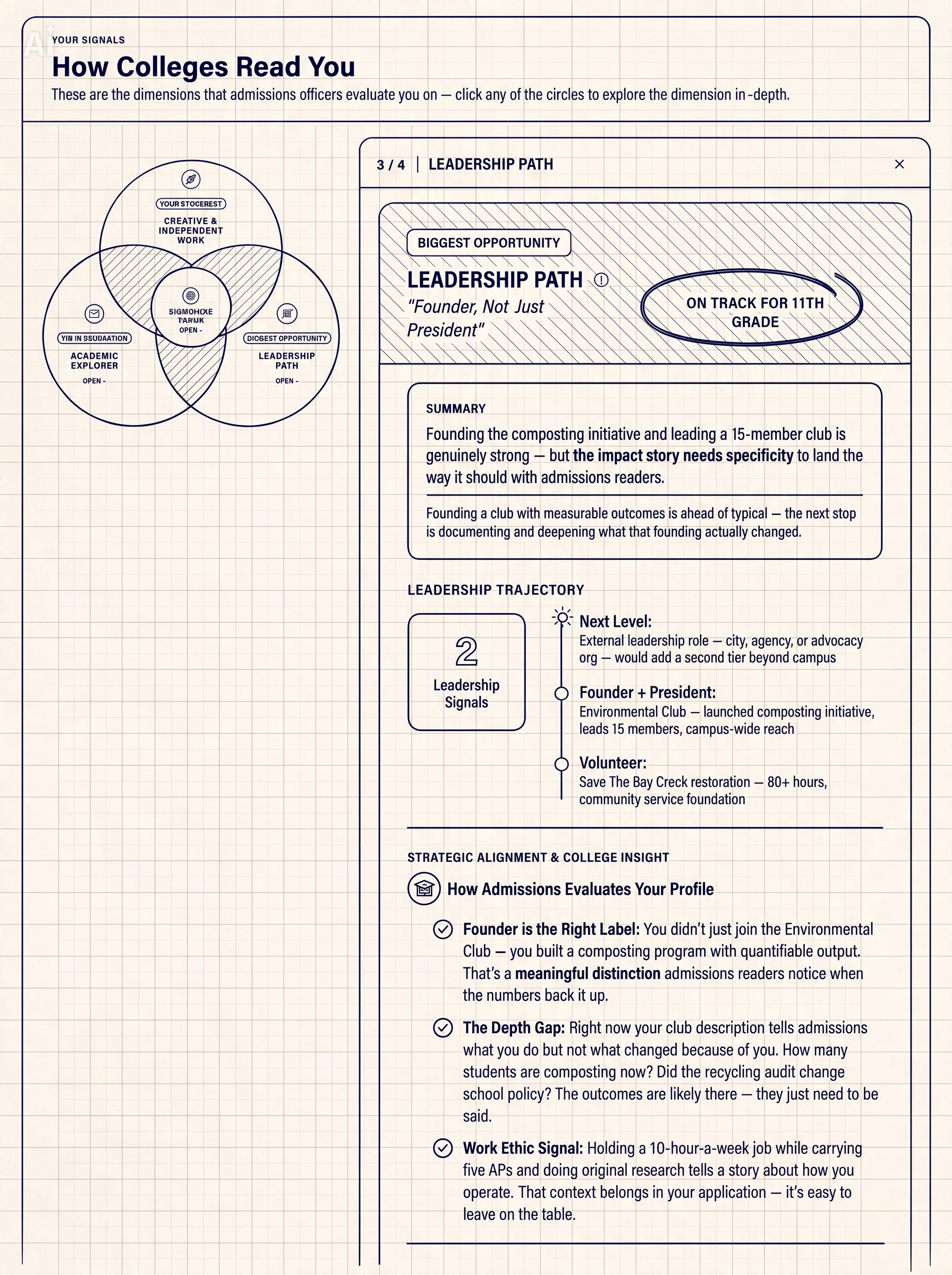
This is what VillageEd changes. It gives families their own first opinion: an honest, written assessment across four dimensions that reflect important signals colleges evaluate, a semester-by-semester plan, and a documented profile of courses, activities, and goals. With that in hand, a parent can evaluate a counselor’s recommendations against an organized baseline rather than relying only on the impressions formed during an introductory conversation. They can ask: Here’s the assessment we have — where do you agree and disagree, and why? Here’s our current plan — what would you change? The quality of those answers helps you evaluate the counselor’s thinking, experience, and fit for your family. That’s not blind trust. That’s informed hiring.
There’s one more thing families buy when they hire a counselor, and it deserves an honest look: exposure to the current market. A working counselor sees a few dozen applicants per cycle and learns where they landed. That produces the advice families find most reassuring — a student with your daughter’s profile got into Michigan engineering last year; two just like her didn’t. Add relationships with admissions officers and the chatter from industry conferences, and a well-connected counselor holds genuinely private intelligence: which majors are quietly becoming impacted, which schools’ test-optional policies mean what they say, where this year’s pile-ups are forming.
Let’s be straight about what software can and can’t do with that. The private, this-cycle whisper network — a counselor’s relationships, their colleagues’ fresh reports, the conversations no database captures — is not something any AI can access. And good counselors are more connected than families realize: through professional associations, member forums, and organized campus visits, an established consultant draws on the observations of hundreds of peers, not just their own caseload. If a counselor truly has that network, it’s genuinely worth paying for.
But it’s worth understanding what that intelligence is, however wide the network: anecdote, passed along in conversation. It arrives without denominators — you hear about the student who got into Michigan engineering, rarely about the full field of similar students who applied. It’s self-reported, unverifiable, and filtered through several memories before it reaches your kid’s case. None of that is a knock on counselors’ diligence; it’s the nature of knowledge that travels by word of mouth. This intelligence is contextual rather than statistical. It can reveal nuances that published data misses, but it should not be treated as predictive evidence for an individual student. Structured data and professional experience answer different questions. Experience can help a counselor interpret context—how a student’s story, family circumstances, and choices resemble or differ from cases they have seen before. Structured data is better suited to tracking published facts across many institutions: admit rates by major, testing-policy changes, Common Data Set figures, essay prompts, and shifting deadlines. A well-maintained platform can monitor a broader set of those changes than any one person can reasonably track manually.
The deeper point is structural. Professional networks move information through relationships and interpretation; platforms organize published information systematically. Each offers a different kind of visibility. A platform’s knowledge compounds in the opposite direction — structured, verifiable, and updated as published information changes. One model of knowledge moves at the speed of conversation; the other is just getting started. That is the direction this entire category is moving, and it’s the quiet logic of the name — it takes a village, and a village that writes things down knows more than any one guide.
In the meantime, the practical move for families is the same one this whole article recommends: use the tool to know exactly what you’re shopping for. If current-cycle intelligence is what you want from a counselor, ask for it directly — How many students with a profile like this did you work with last cycle, and where did they land? And how do you use experience from past students without treating those outcomes as predictions for my child? Either way, you’ll know — and that’s the opposite of hiring blind.
Skepticism about AI is healthy, and parents are right to ask hard questions. A few things separate a trustworthy system from a toy:
Structure over open-ended chat. VillageEd isn’t a blank text box. It’s a defined path — six milestones from Profile Insights through a completed application profile — where the AI works inside guardrails, on a specific student’s actual courses, grades, and activities. The output isn’t vibes; it’s a plan with named tasks, contacts, and deadlines.
Everything in writing. Every assessment, every recommendation, every task is documented and inspectable. Parents can read it, question it, and watch whether the plan holds up semester after semester. Guidance you can audit is guidance you can trust — or challenge.
Honesty over flattery. The whole premise is an honest picture of where a student stands across rigor, depth, leadership, and narrative. VillageEd is designed to surface strengths and gaps plainly, without sales commissions or pressure to flatter the student.
Privacy by design. Students can use a nickname; no legal name, birth date, or sensitive information is required. Data is encrypted in transit and at rest, never sold, never used for advertising.
Deliberate pacing. Each module refreshes monthly — a real recalibration when grades or goals change, not an anxiety slot machine. The plan spans through 12th grade but surfaces only the current semester’s tasks.
VillageEd tells families what it won’t do. It won’t guarantee admission — nobody honestly can. It won’t pressure a fifteen-year-old to pick a major. And it explicitly positions itself as a complement to counselors, not a replacement — because judgment, relationships, and advocacy are human work. In a field where families must evaluate qualifications and claims carefully, stating clear limits is an important sign of credibility.
What families gain from VillageEd:
VillageEd builds a nuanced understanding from the student’s full story—not just grades and activities, but motivations, ownership, goals, constraints, and responses to adaptive follow-up questions. A counselor can add another perspective through live interaction and an ongoing relationship.
For families who cannot afford private counseling, that baseline provides a clearer way forward. For families considering a counselor, it makes the hiring conversation more informed. And for families already working with one, it can reduce the time spent rebuilding records and tracking routine details, leaving more room for the work in which a skilled counselor adds the greatest value.
Start with a written picture of where your student stands and a prioritized plan for what to do next.
Launch price · $499 per year
Build my student’s baselineStudents may use a nickname. Data is encrypted and never sold for advertising.